Into China

Double-heading

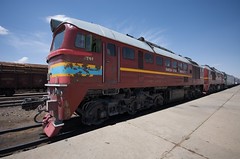
The train from UB to Beijing was extremely new – still the same basic arrangement (four bunks to a cabin) but with excellent air-conditioning, DVD players, a power socket in the cabin, better sanitation and even a shower. Quite a change compared to the train from Moscow. The ride was also better, though maybe due to better Chinese trackwork.

Before China though, was a day traversing the Gobi desert – a surreal experience of watching a proper desert go by, with the information displays reporting an outside temperature of 37 degrees, as you sip beer in air-condition splendour. It’s hard to convince yourself the windows aren’t in fact a projection. During one brief stop in the depths of nowhere ((The kind of place you feel exists to avoid a huge blank space on the  maps)) I was able to sample the outside air – I’d forgotten how pleasant a true dry heat is, compared to normal tropical humidity. At the border reality intrudes – there’s a rapid (only a couple of hours!) Mongolian departure, an arrival into China accompanied by speakers blaring out what I assume is the national anthem, and then … the bogie change. To accommodate the transition from Russian guage to standard guage, the entire train is pulled, ripped, apart, one carriage at a time (much shunting and jerking), each carriage hoisted up off its bogies, and in a dramatically rapid event, the old bogies are pushed out, and the new ones pulled in, before the carriage is lowered down on top. Then the whole train is re-assembled (more shunting and jerking), immigration completed, and finally (it now being 1am) time for sleep. The memory of watching the preceding carriage being shunted into us (to re-engage the coupler) will remain with me for some time I think.

The morning journey into Beijing was accompanied by some ‘real’ Chinese scenery; firstly a rural landscape, complete with rice fields, gradually turning more industrial, and then a dramatic section along a gorge, descending through tunnels, over bridges and along steep (vertical) hillsides. Finally plenty of time rolling into the suburbs and finally heart of Beijing. Along the way we passed through what is evidently a new main station, which ultimatley looks as if it will rival Waterloo in size, and an ICE test unit – apparently the Chinese are getting a high-speed rail link between Beijing and Shanghai, which makes a lot of sense.

Leave the first comment

Into the Hills

Took an overnight trip into one of the national parks to see more of Mongolia – including staying in a traditional felt tent, which are apparently called ‘gers’, instead of ‘yurts’. The setting was absolutely stunning, with green and brown steppe rolling off to the horizon. The afternoon included some ‘horse-riding’, but this was strictly a token gesture – no riding was required, just sitting atop a tired-looking Monglian horse (they’re tiny) while it did what the guide told it. We were looked after by a local family, who have four gers in addition to their own home – which was made of wood, not felt, and contains the rudiments of modern living – a sink, a tub-loading washing machine, and a PC running a 3D shooter. The mains power was visible, no sign of a phone line, but I had full GSM signal strength (so, better than my flat in Edinburgh, then) the whole time, so maybe they’re online as well. Scary.

Modern Conveniences

In general, rural Mongolia looks like a terrain rendering demo. If you take a detailed height map, apply a generic, featurless green/brown texture, some nice, strongly directional dynamic lighting and a sparse covering of trees, you get Mongolia. If you want to get really fancy, add some sandstone rock outcrops. I’d love to return with some proper climbing gear – all around were places that looked climbable with some basic equipment – I ascended a couple of metres in a few places, but descending is trickier, and Mongolia is not the place to injure oneself.

Mongolian Horses


Despite being pretty warm during the day, at night the temperature dropped fast, so the wood-burning stove in the ger was lit. This lump of cast iron rapidly became very hot, and combined with the insulating walls of the ger, and a thick duvet, a good night’s sleep was had. That night was almost a full-moon, which sadly precluded seeing many stars – but for the first time ever, I witnessed really clear moon shadows, beautiful.

Ger

2 comments so far, add yours

UB

Old and New

Sunday was spent exploring glorious, scenic Ulan-Baatar. Thanks to Soviet planners (and a huge amount of concrete) the city centre lacks character, and modern changes aren’t necessarily an improvement – several large, glass-walled high-rise developments look more suited to Dubai than Mongolia. But the centre is compact, pleasant to stroll around (apart from when the air is filled with dust) and low-stress. The hostel was busy, staffed by friendly people and well-located – also they pick you up from the station, one of those little things that makes such a huge difference at 7am off a train.

The major tourist site in the city is the Buddhist monastery ((like a convent, but with male nuns)) of Gandantegchinlen Khiid. While on a smaller scale than other sites I’ve visited, this has some pleasing touches, such as countless prayer wheels to set spinning. Less helpful was nearby and loud campaigning for the upcoming general election. ((Which was also an issue at dinner one evening – the restaurant apparently having been adopted for some kind of rally or pre-election junket)). The major draw is a 25-metre high Buddha, actually a state-funded replica of one relocated by the Soviets to, of all places, St Petersburg, in 1938.

The natural history museum contains the expected assortment of the taxidermist’s art, but is most notable for an impressive collection of dinosaur fossils, locally sourced from the Gobi. There’s a great range of specimens, including eggs, hatchlings, the usual massive bipedal carnivore (with tiny fore-arms), but most impressive was a triceratops-style quadruped locked in battle with a velociraptor. The piece captures a very dynamic scene, with the velociraptor clawing at the quadruped’s face, while it plants a heavy foreleg on the raptor’s chest.

Food-wise, UB is much cheaper than Russia – and whilst ‘traditional Mongolian’ food seems to be as rare as hen’s teeth, there’s plenty of good things on offer, such as an American-style restaurant, with pancakes and hash-browns for breakfast. Unfortunately a side-effect of the modern re-development is that various places listed by the book seemed to have vanished (though one was merely hiding down a back alley, it transpired).

Leave the first comment

From Mongolia With Love

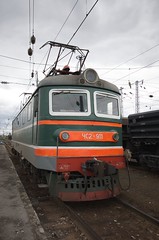
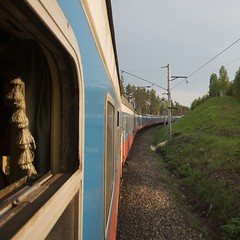
The 5am (local time) train from Irkutsk began the journey to Mongolia and UB – the track follows the south shore of lake Baikal for some stunning sections; since the lake isn’t tidal in places you’re very close to the water. Over the course of the day the landscape changed more dramatically in a few hours than in the entire three days accross Russia from Moscow – the endless forrest finally giving way to some scrubland and then real steppe. This train had a real restaraunt car, a far more pleasant place to while away some hours drinking tea, then a beer and delicious stroganoff while watching the world pass by – excellent. Since the the restaurant is the last car, on the numerous sweeping curves the whole train was visible snaking ahead. The line also features plenty of steep gradients, and once you leave the trans-siberian mainline, it’s not electrified – the locomotive was a (relatively) compact but smoky unit which I guess is gas-turbine based. Each carriage on this train used coal to heat water, so there was the lovely smell of burning coal, and a black smokey plume visible above the train, despite the lack of steam traction.

Into Mongolia

At 6pm, arrived at the Russian side of the border – where we stopped for four hours while customs and immigration procedures took place. The time passed excruciatingly slowly, then finally we were hooked up to a ferry locomotive which hauled us (at a crawl) the short distance through no-mans-land – complete with barbed wire, flood-lights and watch-towers. Mongolian immigration and customs was quicker, but still took a couple of hours; by 1am (Irkutsk time) we finally moved off and went to bed. The Mongolia officials were considerably more pleasant (and smiling) than their Russian equivalents.

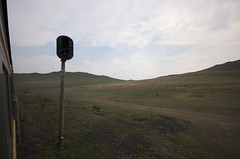
In the morning, prior to arriving into UB, the scenery was utterly breath-taking – endless green steppe rising up, occasionally looking along the length of huge valleys disappearing west and rising up, all empty of any sign of life. Sadly UB itself was announced by Soviet-era industrial sprawl and power-plants.

One comment so far, add another

The English

This is the second book I’ve read by Jeremy Paxman, and something I’ve considered picking up in the past. It’s a description of English psyche and self-image as a nation, how it developed over the centuries, and how it continues to develop (some might say errode) in present times. There’s plenty of historical research, and quotes and material based on interviews with scores of worthies from accross the political and social spectrum, but I found the overall results slightly bland – interesting enough, but mostly factual material with very few actual insights.

In constrast, the previous work I read, ‘The Political Animal’, has a similar format (interviews, quotes and research) but had a clearer narrative progression and generall kept my interest. ((It also features one of the greatest ever ‘endorsement’ quotes on the back cover: “It left me disappointed” – William Hague)) There was one conclusion I thoroughly agreed with, best expressed by a British architect now working in the Netherlands – most of Britain has never really embraced an urban lifestyle, always asspring to live in sight of fields, and hence forcing the suburban sprawl ever outwards. There were some classic quotes from even recent prime ministers using a long-dead vision of rural Englang as rhetoric, followed by material from long-standing residents of such places – mostly despairing about the arrival of the noveau riche from London, who promptly start complaining about the mud and smell, and demaning things be prettied up.

Leave the first comment

Baikal


Across Baikal

Visited the largest lake in the world, Baikal, containing some decent chunk of the world’s fresh, non-frozen water. Thursday was grey, wet and horrible, so after the one hour minibus ride from Irkutsk, standing on a raining, cold waterfront felt just like the English seaside, complete with greasy cafes. Fortunately the chalet was awesome – tea, coffee and delicious ginger-bread were provided upon arrival, which was lovely. The forecast for Friday was proved correct (clear skies and sunshine), so having gone to sleep with a grey view, awoke to a green valley, blue water and distant snow-capped peaks – beautiful. Friday was squandered on strolling around the waterfront, sitting in the sun, and drinking beer with a couple of random Aussies – very demanding, almost like being on holiday or something.


Glorious Siberia

I am convinced that if you could open a ‘proper’ English chip-shop on the waterfront, complete with British beers (the number of English pubs, even in a little place like Irkutsk, is bizzare), you’d have locals and foreigners queuing down the street.


Mongolia tomorrow. After a ten hour border crossing. Joy.

Leave the first comment

Irkutsk


Irkutsk House

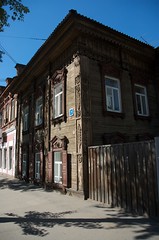
A lazy day (I overslept) wandering around Irkutsk, a pleasant place of aging wooden houses which wouldn’t look out of place in the wild west (which makes sense, since this was a frontier town of sorts, when the reasons to be here were fur and lumber). Much warmer here, and humid too. Lots of small useful things achieved – collected onward train tickets, sorted out a Baikal plan, washed clothes. All terribly exciting.

Leave the first comment

The Train


Russian traction

The train, indeed. Almost eighty hours, the thick end of four thousand kilometers, no stop longer than forty minutes. The train is a good place to read, or (apparently) imbibe beer from three liter plastic containers, or sleep. Except it’s not great to sleep, due to the narrow bed and constant movement. I was really glad of a shower when finally reaching terra firma in Irkutsk today, and those around me were even more relieved I suspect. Trains run on Moscow time; at the destination it’s five hours ahead of that, so my body clock is not terribly happy right now. Due to daylight-savings oddities UB and Beijing are an hour behind, but that’s a trivial change comparatively. It turned out the ticket included food – assorted snacks and one hot meal a day, which was about right (allowing for what I’d brought along). The food was palatable but very bland, tabasco or similar would really help.


Down the line

The train never goes particularly fast – not slowly, but never really flying. I suppose nothing about the network is build for high speed running. Braking in particular is pretty jarring, and at every long stop (several per day) people in high-vis bibs walk along the train tapping the axle covers and main springs with hammers. Presumably this is to detect failed or failing pieces, but it doesn’t exactly reassure. On the other hand there’s plenty of seriously rough junctions and long sections of old-style joined track. The noise is magical when awake, and hellish when trying to sleep (as is the accompanying osciliation).


I expected to see a gradual change in the landscape from day to day, but really there was almost none, from half an hour outside Moscow until reach Irkutsk. It did bring home what an enormously big country this is, and how many trees it contains. I mean, a lot of trees.

2 comments so far, add yours

Ringworld

Finished my first Larry Niven novel, having opted for the obvious choice, Ringworld. It’s still a great work, not dated in any significant way, with lots of really well developed scientific ideas, and a very strong ‘Culture-ish’ feel to it. The weakest aspect for me was the characterisation – by the end of the book I still felt zero connection to any of the four principals, whether they lived or died, or anything about them. I guess in this sense it’s pure sci-fi, with the characters mere vehicles for the plot and concepts.

Overriding everything, starting from the title, the cover, and working on in, is the Ringworld, the sliced Dyson-sphere of the title. Sadly for me the concept will always be shaded by the best known recent things it inspired – Culture Orbitals and the game currently keeping Microsoft in the black. In particular, the sections of Consider Phlebas which are set on an Orbital make the narrative impact weaker, at least for me. Of course the other logical conclusion is that Iain Banks was strongly influence by Niven, which recommends him all the more highly.

The most irritating plot device for me, was the exploration of luck as an inheritable trait, and its use, in the form of pre-destination, as a tool to advance the plot. While necessary when dealing with a habital surface on the scale of the Ringworld. It seemed like a very easy tool to explain many things away.

Leave the first comment

Final day of Moscow and the Train


Gorky Park Ferris

Spent a leisurely final day in Moscow taking in the ‘Sculpture park’ which I’d hoped would be a Goldeneye-style graveyard of Soviet statues, but was mostly taken over by contemporary Russian pieces, much less interesting. My theorey is all the Soviet pieces have gradually flogged to overseas buyers, and replaced with the local pieces (which are probably far more interesting to the locals). Then on to Gorky Park ((the “park of Culture’ if you insist)) next door, which is a pleasant place to stroll, though the rides are either mediocre new ones or terrifying Soviet-era ones which only the terminally foolhardy would trust – notably a ferris wheel with large rust holes and tired looking bearings.


The park also contains what I guess is a full-size mockup of Buran – badly weathered and presented, but still, in all it’s glory, an object designed to boldly go. ((Wikipedia says the airframe in the park is the static-test mockup, which makes sense from its physical condition)). The resemblence to the orbiter is, uh, quite remarkable.

The rest of the day was occupied with excitement such as ‘what food to bring on the train’, and trying to escape the hostel which had been invaded by English girls (of the annoying kind) and Indian women, the latter protesting vocally about, well, pretty much everything. Most notably, having booked to stay in a hostel, they seemed unclear on the notion of shared dormatories. The train was boarded with whole minutes to spare (having navigated the Moscow transport hub arround Yaroslav station, more by luck than judgement).

2 comments so far, add yours