1812

Dithering in a (well-stocked) foreign-language bookshop in Moscow, I felt compelled to pick up something (for the trains) at least vaguely related to either Russia or China. Apparently 1421 is not that great, and I really didn’t want to lug around War & Peace, so settled on 1812, a factual review of Napoleon’s march on (and then back) from Moscow. My background knowledge of the period essentially comes watching Sharpe, but the book is well written, with a good structure and decent amounts of detail without getting bogged down in trivialities of military units, the Russian aristocracy or French politics.

Apparently the story of the French invasion has been retold (with ‘interpretation’) many times since the original events, as the relative status of Bonaparte has varied in the public perception, and as different ruling factions in Russia have sought to emphasise political causes du jour – such as defence of the country by the peasantry, the competence or incompetence of the aristocratic Russian officers (or indeed the Tsar), or to instill a fear of foreign invasion.

The book took some time to finish – it’s about the right length (allowing for the voluminous footnotes), but depressing reading – at every stage in the events, the suffering and loss of life is immense. Of course that’s the nature of conflict, but the sheer pointlessness of the exercise at the strategic level, and the utter incompetence of the commanders at the tactical level, combine to bring home the futility of the undertaking. It’s all here – men freezing to death as they stand, cavalry charges where five men survive from three hundred, troops being held in reserve for an entire battle, broken chains of command due to personal rivalries, all of it. 

Leave the first comment

The Summer Palace

Apparently central Beijing was a place be avoided in summer, even before the smog. So the later emperors would escape to a pleasant country retreat a few miles to the north west. It’s a sprawling collection of buildings dotted around a lake and hill, now filled with locals and tourists. None of the structures are particularly old – the original buildings having been demolished, by, uh, us ((twice, no less – with some help from the French, another of those fine Anglo-French collaborations that have so improved mankind’s lot)) – so the whole complex was rebuilt by the Dowager Empress Cixi, using money which had been ear-marked for the frivolous task of rebuilding the Chinese navy ((The previous navy having been sunk by, err, us)). The hill and lake are completely man-made, and indeed the whole landscape feels completely managed and artificial – it’s nature, and beautiful, but meticulously arranged and regulated. Incidentally, the aforementioned empress appears to have been a crazed, power-hungry despot to rival the best of them, and possibly even precipitated the collapse of Imperial China due to her excesses and complete disregard for the general population.

The haze and smog meant the views across the lake weren’t spectacular, but it’s a pleasant place to stroll around, with paths, hills and gardens dotted with pagodas, gates, bridges and temples. Apparently in winter the lake freezes and is used for skating – it’s definitely a place I’d return to if visiting Beijing in a different season. Incidentally, it’s another place which will soon have a direct metro stop, greatly simplifying access.

Leave the first comment

Eating out in Beijing

Culinary delights in Beijing

  • There is, if possible, a higher density of restaurants than I’ve seen anywhere else, including downtown SF, the curry mile, and so on.
  • The duck is really good – the same basic idea as in the UK, but executed to perfection.
  • The hot-pot is the most fun ‘self-assembly’ meal I’ve ever had – I find fajitas rather tiresome (alright, mostly I just prefer enchiladas) and fondue gets boring pretty fast, whereas the hot-pot is a great collection of flavours, especially given the bewildering combinations of sauces, bases and meats on offer. Tender cuts of beef, cooked for a minute, dipped in delicious sauce – absolutely delicious. It’s noticeable that the staff hover around after delivering the dishes, to provide some instruction, and presumably avoid idiot Westerners giving themselves food poisoning.
  • Middle-eastern dining at ‘1001 nights‘, good food (especially the falafel) and delicious baklava, accompanied by spectacular decor and cheesy belly-dancing. Not cheap, but fairly authentic (lacking a decent meze to start) and a welcome break from Chinese.
  • Szechuan, I was warned it might be ‘quite spicy’, but was actually far more flavoursome and less hot than I was expecting based on the dishes labelled Szechuan in the UK. I suspect the spice levels in the UK are either focused on to excess, or used to mask poor quality ingredients or inattention during preperation. Whatever the reason, my Beijing Szechuan experience was some of the most interesting Chinese food I had – I’ll try to find some good specialist places in Edinburgh and London now.
One comment so far, add another

Wonderland

The Zhongguancun tech-plazas are a cavern (well, several caverns) of unearthly delights. Assuming one is any kind of hardware geek whatsoever. Finding the place was something of an ordeal, mostly due to my pig-headed insistence on trying to walk from the nearest metro stop – that will be a fine idea once line ten is open ((about three days after I departed Beijing, apparently)), but encouraged by the essentially fictitious map the hotel supplied, I endeavoured to walk from the ‘closest’ line thirteen stop, which was, uh, a mistake. Much walking, a taxi ride, some more walking and increasing frustration later, I entered a building which sold laptops, and then gradually realised that actually there was five floors of goodies, and across the street, several more complexes along the same lines, but even larger. The setup is essentially a market – thousands of small vendors, between them purveying all manner of shiny. Phones, laptops, music players, camera lenses, processors, motherboards, it’s all here, each brand repeated fifty times over.

To my surprise there was a strong representation of the mothership, but absolutely no (that I saw) Sigma presence, despite boxes and boxes of Nikon and Canon lenses – very odd. The Hong-Kong based eBay retailers certainly have no problem sourcing the Sigma gear, so I’m perplexed by its absence.

The tragedy is, despite the collection of wonders, for me personally, there’s very little I could actually consider buying – phone-wise I’m waiting on the second incarnation of the JesusPhone, I am infinitely happier since I abandoned the PC hardware rat-race, and the video cards on offer don’t work in my MacPro ((Which, as a loyal drone, I blame Microsoft for completely – why the hell couldn’t Vista use EFI?)). I made do with some UV lens filters and escaped with my wallet basically intact – no doubt others are not so lucky. 

Leave the first comment

Climbing the Wall


司馬臺

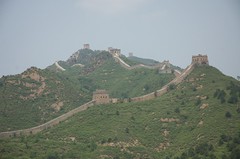
On a Monday morning, after three hours on a bus escaping Beijing and climbing into the hills, spent a few hours at Simatai walking on the Great Wall. I was delighted that the wall really does live up to expectations, and was almost deserted, even with a cable-car providing access to the top. Walking from tower to tower, over curving, twisty sections, some perilously steep and all balanced on ridges above plummeting valleys, you feel you’re getting a pretty good sampling of ‘the wall’, or at least the Ming dynasty version of it. In spite of the long ascent, there’s still people anxious to sell you their wares – whether it be cold drinks, postcards or carved seals, but compared to other sites, they are infrequent and pleasant.


Standing on the section at Simatai, which is in a good start of repair, the expenditure of effort and lives to create the wall is brought home – the wall snakes off to the horizon in both directions, plunging down hillsides and charging up again. One surprise was how closely spaced the towers are (again, on this section) – only a few hundred metres apart, and each a substantial structure with multiple floors. I’m somewhat motivated to spend a day or two exploring Hadrian’s Wall again (not having been since childhood), by way of comparison.


The Great Wall

The weather even obliged by raining the night before, clearing to actual blue skies (escaping the Beijing smog may have been a factor as well) and holding that way for a three hour stroll, before turning back to overcast grey and rain as we boarded the bus back to the city. The first part of the road back was hindered by countless slow-moving, heavily laden trucks struggling up the inclines, and in many places broken down. This made for some exciting manoeuvres as our bus pulled out to pass a stricken lorry, only to encounter other lorries oncoming, or the driver of the broken vehicle would emerge into the road (from somewhere in the underbelly of his machine) right into our path. I would be extremely reluctant to drive any kind of vehicle in China.

Leave the first comment

雍和宮

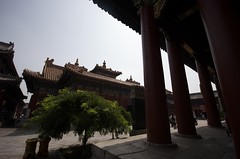
Yonghe Gong, aka the Lama Temple, is the largest Tibetan Buddhist temple in China – it’s an impressive, if predictable, site (tiled roofs, red columns, gates, halls) which somehow survived the Cultural Revolution without being bulldozed. The exact details of how this occurred seem to be slightly mysterious and not dwelt upon by the literature. The ancient Buddhist monks helpfully sited their temple next to a metro stop, something the emperors should really have paid more attention to. ((We managed it in Edinburgh, as the apocryphal American tourist pointed out – “It’s great that they built the castle so close to the train station”))


Yong-he-gong

Architecturally, the place is large but not sprawling – a relatively dense collection of temples, courtyards and halls – there’s none of the vast open spaces of the Forbbiden City, instead there’s a succession of much more compact squares, each containing trees, shrines, statues and huge, smoking incense pots. Each hall contains multiple Buddhas in various poses, and despite being a tourist-trap many visitors are actively praying before them. The street outside is lined with shops selling large bundles of incense, and inside the air is thick with the smell – it seems that the efficacy of the prayer must be correlated to the tonnage of material being burned.

Leave the first comment

This city is not for you.

The Forbidden City is really quite big, and unlike in the films, full of tourists rather than ninjas. Sadly two of the largest halls were closed for rennovation, but it doesn’t really matter – it’s not the individual places that impress, so much as the continuity of style, repetition of elements and overall scale of the site that are spectacular. Each time you pass through a gate into another courtyard, or turn a corner of a passage, you’re met by another view of red columns, paved squares, carefully manicured plants, tiled roofs, and so on. This is aesthetically stunning, but also rather sterile (and rapidly becomes oppressive in the heat, despite making an early start). I think it’s the kind of place where a team of re-enactors could make a huge difference, and also provide great camera-fodder – a few ceremonies or processions being recreated would really bring the sights and sounds of the place to life.

Even without such lures, however, the place is busy with tourists of all kinds. Fortunately the scale means that off the main drag, there’s no real crowd pressure, and with a few turns down side-streets you escape the crowds altogether. It’s also surprising how completely the modern city is removed – I expected the ever present sounds of car horns and sirens, and the horizon dotted with skyscrapers, but this is not the case at all. Off the beaten track, in the east or west palaces, there’s peace and tranquility in abundance.

Leave the first comment

北京

Beijing is huge, and humid, and amazing.

Arriving on the train, there’s enormous high-rise apartment blocks everywhere, and in the centre, lots of glass and steel. There’s also Olympics logos and branding (and merchandise!) everywhere. Bizzarely, despite this high-rise grandeur, the centre is actually still quite open, since the combined space created by the Forbidden City, Tianamen square and the moderately-proportioned nearby buildings means there’s no sense of crowding (comapred to, say, Bangkok or Manhattan). Of course it’s easy to be moderately proportioned given the scale of the space – buildings that would otherwise loom fit naturally alongside the wide streets.

In contrast to the high-rise glass and chrome, the traditional hutongs are essentially single-storey, full of traditional courtyard based houses. From the outside, strolling along narrow streets and even narrower alleys, it’s hard to tell what an area is like – some of the houses have been refurbished with every modern convenience, others are little changed from a century ago. The strangest aspect was that having finally awoken to the cultural ((i.e, lucrative touristic)) value of the hutongs, the area closest to Tianamen square was being rapidly gentrified and rebuilt, with pavements, relaid streets and new brickwork.

One major annoyance – none of the cash machines seem to like my bank card, despite all proudly displaying the Visa logo. Some reject the card quickly, others go through considerable clicking and whirring before aborting the transaction.

Leave the first comment

Bzzzzzzzz

Caution! There are bees! Also, apparently we’re transporting bees around to pollinate crops? That’s got to warrant a new haz-mat symbol – the lorry ahead of you on the motorway could be filled with buzzing, stinging death! And also delicious honey.

One comment so far, add another

Cyrillic

After a few days of confusion, I’m starting to get somewhere with Cyrillic. Initially the issue was mental gear-changing; unlike some other scripts, your brain (mine, anyway) keeps trying to process Cyrillic directly, and then throws an exception. Now I’ve mostly turned it into a glyph substitution algorithm, which I’m sure a Russian language speaker would be appalled at.

Recognition is aided by shared letters (most of the vowels), plenty of trans-scribed names to compare, and similar language sounds, so after a few days of exposure, it’s possible to muddle through most street signs – it helps that the Russian sounds and words are very much in the north European language family. There’s plenty of words where the Russian is evidently based (in ancient, or recent times) on the same Latin or Greek root as ours. None of this is to claim that learning Russian would be particularly easy, but I don’t think reading would be the barrier to comprehension that it is in other places.

Leave the first comment