The Metro


Metro

Saturday morning was spent (briefly) exploring the Moscow metro. Hopefully the pictures will do it justice, but it’s another of those tributes to what awesome things you can build if you don’t mind sacrificing really large numbers of people in the process. Aside from the blood flowing down the tunnels, the station spaces are amazing – from the escalator tunnels, the ticket halls, the over-bridges through to the station tunnels themselves, everything is enormous and high and beautifully arches. There’s little litter, almost no advertising, high quality buskers (so far, a string quartet, a bass guitar + trumpet combo and an beautiful solo violinist), and everywhere there’s a sense of restrained opulence – lots of bronze and brass, but no gold.


The service is extremely frequent, and the larger heights mean the atmosphere is less stuffy than the London system. Though I’m fully aware there are Scandic saunas less stuffy than the Northern line in summer.


Metro

Naturally, it’s not all great – there’s lots of staff, being less than helpful or doing very little; each escalator tunnel has a grey-haired witch at the bottom in a metal cabin,  eyeing the passengers or simple reading the paper. Perhaps the worst thing is not the Cyrillic letters (which are getting easier) but the poor iconograpghy / visual design. It’s impossible to work out which station or line you’re on as you arrive at a station, the name being obscured and in low-contrast colours. Interchanges are almost never co-sited, so every line change is akin to the Monument-Bank situation (not all, to be fair). At least the interchange tunnels are equally massive – larger than a LU station tunnel.

One comment so far, add another

More Moscow


Inside the Kremlin

Visited the State History Museum in Moscow, it’s extremely typical in terms of the exhibits, though with some quite fantastic external and internal architecture – each room has a different theme, concept or historical inspiration. The exhibits commence with prehistoric artifacts (flint axe heads) and progress through to nomadic times, then on to the Imperial period and Mongol invasion and occupation. The entire upper floor is devoted to costumes, regalia and pieces from the Romanov era onwards, and I paid it little heed, since there’s almost no interpretation in English and visually it seems almost indistinguishable from European equivalents ((presumably that was the foremost intention of the designers)). The funniest part by far was a comment, in the English-language interpretation attached to a paleolithic room, about early prehistoric social and family groups being the ‘first instance of social equality and collectivism at work’. Ummm.


St Basils

On to St Basil’s, actually a misnomer. The exterior is well photographed of course, but the whole building seems much smaller in real-life, and the interior lacks the great open space of St Paul’s or Notre Dame – you ascend a narrow staircase from a ground floor of vaults and chapels, to a main floor which seems like a warren of chambers, the largest perhaps eight metres in breadth – but soaring upwards twice or three times that, with light pouring in. The largest chamber contained a four part male choir whose singing reverberated beautifully inside the structure.


Lunch was at a up-market cafeteria style eatery called ‘Moo-Moo’. The food is good, but the decor is dubious, with huge Fresian prints on the menus, tables, walls and anywhere else handy. Tolon-tolon flashbacks ensued.

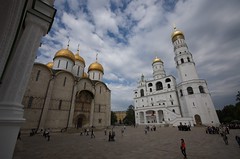
Then on to the Kremlin proper, which is a curious mix of still highly-official buildings, such as the official residence of the president, and public spaces. The former Senate has been turned into a theatre used for opera and ballet. The main interest for tourists is the four ornate (gilded) Orthodox churches, with stunningly gaudy interiors, raised to the greater glory of whoever was running the country at the time. Well, there’s two more tourist traps – a giant useless broken bell, and a giant useless cannon, with over-sized balls.

Finally, a stroll down the Arbat, a pedestriansed and tourist-friendly shopping street, with many portrait-drawers and purveyours of Russian dolls. Also a set of stalls in a  cluster, each with a person and a small ornate dog, heavily groomed and ‘dressed’. I was extremely unclear what service was being offered – the dog, the dog’s offspring, or simply a chance to hold the dog.

Leave the first comment

Москва́

Arrived in Moscow at 6am ((but this was almost an hour later than scheduled, quite usefully)) and crashed out at the hostel which thankfully has comfy couches and other useful amentities, such as fast, free internet. The hostel is another converted apartment (actually two) but the scale of such apartments as originally built is pretty impressive, the ceilings are actually higher than in Edinburgh or Glasgow.

After an easy stroll to Red Square, paid a visit to dead embalmed guy number two (of a three part set). The setup is the same as visiting uncle Ho, but with a short queue. Lenin himself looks very small, and somehow less lifelike than Ho – but I think that’s mostly the extreme pink lighting used to improve his complexion. Behind his tomb the great and good of the communist era are buried along the east wall of the Kremlin. And Stalin.

Red Square itself is impressive, bounded to the west by the immsense wall of the Kremlin, the north by an ornate museum, the south by St Basils (much smaller in real life than all the pictures make it seem) and to the entire east side by the GUM, which is an amazing arcade of pillars, bridges, columns and an arched glass ceiling. Inevitably all the shops are the expected lineup of Western designer boutiques, but walking around the space is delightful, at least when the sun is pouring in from above. After fleeing the outrageously prices of GUM, I did manage to locate (thanks to Lonely Planet) a well-stocked foreign-langauge bookstore, to remedy an accute shortage of reading matter. ((Would someone please make a decent e-book reader already? Dead tree is a rubbish way to move text around.))

2 comments so far, add yours

Petrodvorets

Quite Restrained Really

Visited Petrodvorets today – Peter the Great‘s summer getaway, orginally located so he could watch his navy being built. It’s a sprawling place, with gardens, fountains and several palaces. You can reach the site by bus or train, but the most thrilling option (and that’s strictly relative) is by (Soviet-era) hydrofoil. Similar to my recollections of hovercraft travel, they’re an odd mix of ship and airplane construction. On the calm waters around St Petersburg, they move smoothly over the water, with a steady rumble but nothing like the din of hovercraft. ((And no signs of impending structural mishap, thankfully))


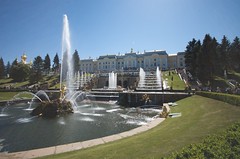
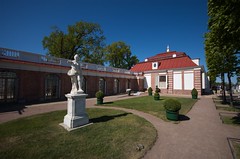
The gardens are mostly trees, not flowers (for climatic reasons?) and rather pleasant; they’re able to accomodate the really large numbers of tour groups the site attracts. The centrepiece is an elaborate fountain arrangement ascending to the hugely gilded main palace – this is impressive, but also absolutely swarming with people. Much nice is Monplaisir, Peter’s original brick and wood-panelled residence, right on the waterfront, where apparently he used to ‘entertain’ guests by forcing them to drink vast quantities of alcohol. ((As with all such references to Peter I’ve seen, my opinion is totally coloured by Neal Stephenson’s portrayal of him in the Baroque Cycle – the problem is the historical facts seem to correspond quite accurately.))

Monplaisir

The weather turned from showers and cloud on the previous days to glorious sunshine – this made the gardens much more pleasant but led to sunburn. Ooops.

Leave the first comment

St Petersburg

Looking North

Arrived into St Petersburg late on Sunday, after a minor delay departing both Edinburgh and then Frankfurt. After some transportation issues, made it to the hostel which reminds me of one I stayed at in Prague – an extremely un-prepossessing stairwell (visually and nasally) but perfectly reasonable accomodation within. Based on the condition of the common property, statutory notices have not yet been dreamt up here.

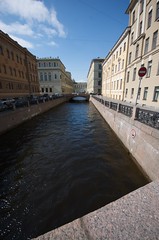
St Petersburg itself seems like an odd cross between central Paris (huge, 18th century boulevards) and Amsterdam (completely flat, with canals). Almost all the buildings are of complementary height, mostly four stories, giving the place a very consistent feel – there’s no skyscrapers towering overhead, nor Soviet-era housing projects.

Visited the fortress, which is understated (if one is expecting a medieval-era fortification) due to its very low profile – useful when trying to dodge canon balls, however. The fort contains an ornate, gilded cathedral where the tsars are buried (and topped by a gilded spire), and next door a museum with the history of the city. The cathedral ceiling includes various terrifying frescoes, most notably a central apex with four cherubs – one of which is brandishing a ladder, and another, a large length of lead pipe.

On Tuesday, visited the Winter Palace which is the expected physical demonstration of how big and impressive a palace one can build if one rules an entire country ((Can’t imagine where Peter got that idea from)). Quite aside from the extravagant architecture (‘this room was built for the wedding of princess so-and-so’), it’s jammed full of art. Most of this was of little interest, but the top floor contains a large number of Gaugins (not to my taste), some Picassos I actually like, and a good smattering of the other Impressionists, as well as a small but interesting collection of recent Russian pieces. The worst aspect of the visit was the half-hour (at least) wait to gain entrance due to the extremely slow moving queue. Walking around the building does start to convey the opulence of the Tsarist era, and the corresponding political ammunition it gave the Bolsheviks.

Leave the first comment

Whorebaggery

Warren Ellis requested people spam the world about the existence of his weekly web-delivered comic, Freakangels. And I am proud to call myself his bitch, in this matter. 

Leave the first comment

Unclear on the notion of ‘fiction’

Deary, deary me. (and thanks to Lum for the catch). Presumably all the previous Indy films had totally believable plots, what with crazy Gestapo guys scouring the middle east for religious artefact …. damn. Still, I’m sure there’s never been any crazy human-sacrifice cults in India. Pretty sure.

Leave the first comment

Tiny acts of … vulgarity

Just completed episode one of ‘On The Rain-Slick Precipice of Darkness‘, the Penny Arcade foray into making games rather than satirising them. This in itself is notable, since I don’t finish many games ((I don’t start that many either, which may explain it)). Assuming you haven’t played the free demo, it’s a modernised adventure game in the finest LucasArts traditions, but with an extensive RPG-style combat engine added on. The LucasArts connection is pretty strong, since the producer is Ron Gilbert, who has made a few of these things before.

Overall, the game is pretty good – it feels like an adult Monkey Island, full of Penny Arcade jokes, decent writing and obscene humour. The rendering (courtesy, it turns out, of Torque, woo) is a nice cel-shaded look, and complements the ‘drawn’ sections (dialogue, cut-scene movies) very well. An added bonus is that the graphical style is simple enough to work on extremely moderate hardware – you know, the kind Apple put in their flagship workstations ((Bitter? Not at all, I assure you. I’ll buy the upgrade kit to the 8800 GTS at some point, it’s only one major limb and a first-born.)). Originally I had the graphics on ‘high’ but had to switch that off early on when I realised the combat sequences were bogging down nastily.

The combat difficulty had me worried for a while; initially easy, then suddenly ramping up to impossible, but this turned out mostly to be because I’d never played a turn-based RPG before, and didn’t really understand how they work – once I’d got over that hump the combat was slightly challenging but nothing more, which given my vast ineptitude probably means it’s laughably easy for hardened gamers. It seems many lessons have been learned about adventure games since the days of Monkey Island – there was none of the ‘try everything with everything’ or pixel-hunting frustration that I recall from such games, and I never had the enjoyment-killing problem of having no idea what to do next. The characters feed you hints, inventory items are marked once they’re used, and the game records the current ‘cases’ (missions) you’re working on. All these things remove the pain I associate with the old LucasArts games (which is why I never got more than half-way into Indy).

All of the above, however, is more or less irrelevant, however. The important things you need to know are that this is a game where you get to kill mimes, and collect illicit meat, and use innocent organic produce to divert tiny mechanical foes during combat. And the animation for that (and the sounds effects, dear lord) are the best thing I’ve seen since Portal.

Sweet fancy Moses.

Leave the first comment

Heal’s Staircase

 Helix

Whilst browsing all the things I can’t afford in Heal’s, found this beautiful spiral ((I know it’s a helix, but if you call them helical staircases in public, you get odd looks. Odder than usual, I mean.)) staircase. Lovely.


One comment so far, add another

British Museum

As an epilogue to my Egyptian trip, spent a few hours at the British Museum today. This was motivated by every second description of an antiquity in Egypt being followed by ‘but you can’t see it, because it’s in the British Museum collection’. Yes, for God, Queen and country, we crated up everything that wasn’t nailed down (and many bits that were) and shipped it back to Merrie Englande. Aside from the Egyptian artefacts (which are spectacular) there’s Graeco-Roman items, similarly, uh, ‘acquired’ from Athens, Crete, Asia Minor and the rest. Many of the description cards use slightly convenient language to dodge around the methods by which the treasures of the ancient world ended up in London, such as being handed over by the French after one of their inevitable defeats, swapped with the locals for trinkets, or purchased from dubious characters.

At one particular site we apparently got even more enthusiastic that usual, and carted away an entire temple, which has been reconstructed.

Upstairs there’s a good British & European section, which is humbling when you compare the chronology; when the Egyptians were building huge temples, we were still making axes from flint. It’s also interesting to compare the artefacts; everything from Assyria and Egypt is stone or pottery, whereas even through to the middle ages, the European items are mostly metal. Especially impressive is the Celtic and Roman jewellery, and the various finds from Sutton Hoo. In general there’s decent interpretation on many exhibits which helps greatly – the replica helmet from Sutton Hoo is stunning, and showing (replica) grave goods arranged in-situ is much more effective than lined up in glass cabinets.

I guess I saw about ten percent of what’s on display – the free admission is a huge benefit, it really takes the pressure off trying to see everything in a day or half-day. And there’s enough space that it didn’t feel packed, despite being busy.

As an aside, the great court is breath-taking. I’d forgotten about it until I walked in, and the sense of light and space is dramatic. The contrast between the geometric lines of the museum buildings and the curves of the roof is pleasing, producing the sensation of the roof almost hanging freely above the square. I hate to think how complex the construction must have been, apparently each piece of glass is unique, and there’s no obvious ribs or supporting members – presumably the entire strength comes from the lattice.

Leave the first comment